Showing posts with label Southside Virginia setting. Show all posts

27 July 2012

Ralph Berrier, Jr. If Trouble Don't Kill Me: A Family's Story of Brotherhood, War, and Bluegrass. New York: Crown, 2010.

From Roanoke.com
As a librarian, I am confronted daily with the truth that I will never read every book I want to read. In fact, I will probably never read every book I should read. Thousands of books stare me in the face every time I go to work, and as intriguing as many of them sound, reading them cover-to-cover is simply impossible. If only the notion that the only thing a librarian does all day is read were true!

That being said, Ralph Berrier, Jr.'s If Trouble Don't Kill Me was so good that I read it once and had to read it again. The story of Berrier's talented grandfather and great-uncle (twins) was fascinating, informative, and moving, and it has something for everyone - music enthusiasts, history buffs, biography lovers, and Southside Virginia aficionados.

Reading If Trouble Don't Kill Me was something of an emotional experience for me, mostly because it combines two of my favorite things: bluegrass music and Patrick County, Virginia. Berrier, a features reporter at The Roanoke Times, is a masterful writer. He artfully weaves his family's story with local and national history and music theory. Even though a reader likely never met his famous relatives, considering what it would have been like to know them and to hear their music comes effortlessly. Berrier's pride in his family never becomes cumbersome, even though it is clear that he is enjoying telling their story.

 Saford and Clayton Hall were born in The Hollow of Patrick County on May 4, 1919 to Judie Hall. Although the twins were the unmarried woman's ninth and tenth children, Mamo (Judie's nickname) had strong support from her mother, known to people near and far as Granny Hall. The twins grew up poor in an area near Ararat "below the mountain" (meaning that they were "looked down upon both literally and figuratively" p. 13). Although they went without for much of their early lives - including britches - the boys were blessed with a musically-inclined mother. Mamo taught Saford how to play the fiddle when he was little enough to sit on her lap, and later when a banjo produced itself in their small cabin, she showed Clayton how to play it, too.

Playing music eventually got them out of The Hollow. First, in the band The Blue Ridge Buddies, Saford and Clayton played in nearby Winston-Salem, North Carolina, on the local radio station WSJS. Later, in 1937, they moved to Bassett to work in a furniture factory; Mamo eventually moved there to watch after them (they were always accused of being spoiled since they were the babies). They played live shows on the weekends and became well known as skilled bluegrass musicians in Virginia and North Carolina. One day Roy Hall (of Roy Hall and His Blue Ridge Entertainers) came looking for the twins to see if they would join his band. The rest, as they say, is history. Of course, this is a history that involves Roanoke's WDBJ, World War II, family tension, loss... and even Dr. Pepper. Fortunately it also includes reconciliation and a lifetime of the magic of music.

As I mentioned earlier, reading If Trouble Don't Kill Me affected me deeply. I love bluegrass, and much of that has to do with the way that it was introduced to me. When I was a child, my sister, brother, and I were "kept" by "Nannie" Reinhardt, a family friend who grew up in Cana (a stone's throw from Ararat). She used to tell us stories about listening to live bluegrass growing up, and we would watch The Grand Ole Opry with her (I distinctly remember episodes with the Statler Brothers of Staunton). Nannie also used to go to local jam sessions. Later, as an adult, I fell in love with the style again with updated approaches, from bands like Nickel Creek and Rose's Pawn Shop. Living in Stuart from 2007 to 2009, I got to experience the genre almost everywhere I went - festivals, high school talent shows, events at the Patrick County Music Association and the Floyd Country Store, and FloydFest (which is actually in Patrick County :) ).

The best part about reading this fantastic book is that even when you have finished the last page, the Hall twin's impact on you does not end. You can listen to Roy Hall and His Blue Ridge Entertainers on a variety of websites and even listen to similar music on Pandora. You can travel to Southside Virginia, following the Crooked Road or going off course, to listen to a wide variety of music (some of which that may have been influenced by the men). And it may even inspire you to pick up a banjo, a fiddle, a mandolin, a guitar... heck, even a washboard... and to find your inner musician - which is exactly what it did for Berrier!

Hear Roy Hall and His Blue Ridge Entertainers perform Orange Blossom Special in 1938.

Watch Ralph Berrier, Jr. introduce us to Saford and Clayton Hall and their story.

---
Have you read If Trouble Don't Kill Me? Please share your opinion about the book and this summary.

What are some of your favorite bluegrass bands and venues?

12 July 2012

Terri Fisher and Kirsten Sparenborg. Lost Communities of Virginia. Earlysville, VA: Albemarle Books, 2011.

From Virginia Tech News
Here is something that I will only say once, and if it weren’t for the eternal nature of blogs, I would deny ever uttering (writing) it from here on out. So all of you out there who bleed maroon and orange, listen up! Here it is: reading Lost Communities of Virginia made me wish that I had gone to Virginia Tech. If I had become a Hokie, I would have gotten involved in the Community Design Assistance Center and the Lost Communities of Virginia Project.

Alas, I didn’t. I went to the University of Virginia, where I got a phenomenal education in architectural history and where I got placed in my first job after college, Patrick County, probably my favorite place on the planet. So not going to VT wasn’t the worst decision of my life, but I am still pretty jealous of the Hokies who got to perform all of the research and write the beautiful book that is Lost Communities of Virginia.

In 2011, the CDAC put out a handsome publication compiling information about thirty of the 2,600 small communities that “[cover] the breadth of Virginia’s geography, history, and community types” (Lost Communities of Virginia Project). What makes these places unique? They have been lost to the hands of time.

06 June 2012

Southside Misrepresented: Heidi Schnakenberg's Kid Carolina.

Outrage!

I was having what was supposed to be a quiet, lazy Sunday morning of reading when I almost choked on my coffee. I had just thumbed through the pictures, browsed the index, and finished the introduction of Heidi Schnakenberg's 2010 publication Kid Carolina: R.J. Reynolds, Jr., a Tobacco Fortune, the Mysterious Death of a Southern Icon when I found it. A glaring mistake. Two of them, actually. And both in the very first sentence of the first chapter.

Before we get to the good stuff, let me give you a little bit of context. The Reynolds family is famous in North Carolina for being tobacco people (and you have probably used another product with a link to the family, Reynolds Wrap). In Winston-Salem, there are still marks of the family's legacy: the Reynolds Building (a skyscraper that was the tallest building in the South when it was built in 1929), the Reynolda House Museum of American Art; the Z. Smith Reynolds Library at Wake Forest University, the Smith Reynolds Airport, and numerous organizations that benefited from the Reynolds' charity.

Even Southside Virginia has a strong link to the Reynolds family. The Reynolds Homestead in Patrick County is a cultural hub for local citizens. Restored and donated to Virginia Tech by Nancy Susan Reynolds (sister of R.J. Reynolds, Jr.) in 1970 as a Commonwealth Campus, the Reynolds Homestead features her father's boyhood home, Rock Spring Plantation. The surrounding community of Critz is also home to an elementary school named for Hardin Reynolds (grandfather of Nancy and R.J., Jr.).
What Schnakenberg gets wrong early on is the matter of R.J., Sr.'s birthday and the location of his birth. As you can see in this image, she claims that "Richard Joshua Reynolds Sr., founder of the family tobacco fortune, was born on July 28, 1850, in Critz County, Virginia, where his parents, Hardin and Nancy Reynolds, had settled after their marriage in 1843" (Schnakenberg, p. 1). The inaccuracy of "Critz County, Virginia," struck me first, but I quickly learned from the North Carolina Department of Cultural Resources that R.J., Sr., was born on July 20th, not July 28th (even Wikipedia had both right). [See the mistakes for yourself here.]

There has never been any county in Virginia named "Critz." The area of Patrick County (the true place of R.J., Sr.'s birth) "can be said to have been included in eight different counties since the formation of counties in Virginia" (Patrick County Historical Society, p. 25). These were Charles City (1634-1703), Prince George (1703-1720) Brunswick (1720-1746), Lunenburg (1746-1952), Halifax (1753-1764), Pittsylvania (1764-1776), Henry (1776-1791), and finally Patrick (1791 to present). The 1770 map below, A New and Accurate Map of Virginia shows the enormous Pittsylvania County.
A New and Accurate Map of Virginia (1770) by John Henry. Key for Southside Virginia counties: 3-Amelia, 6-Bedford, 7-Brunswick, 8-Buckingham, 11-Charlotte, 15-Dinwiddie, 23-Halifax, 35-Mecklenburg, 43-Pittyslvania, 44-Prince Edward, 52-Sussex. From http://memory.loc.gov/ammem/collections/petitions/repecomp.html.

Henry County (formed in 1776) was named for Patrick Henry, Virginia's first governor and "one of the firebrands who had helped to stir up the people of the colony in their fervor for independence" (Patrick County Historical Society, p. 38). Fourteen years later, Patrick County was formed from western Henry County. Retaining the honor to Patrick Henry, when one looks at a map of Virginia, they see the two counties, side-by-side, that spell out his name (as seen in the 1920 map below).
From http://www.newrivernotes.com/va/patrick.htm.
Today, Critz is little more than a crossroads with the elementary school, a post office, the Reynolds Homestead, and a handful of churches. As history and heritage shows, there was never a county called "Critz County."

After picking up on these two inaccuracies, I had little interest in reading any further. Sure, they could be the only two mistakes in Schnakenberg's work, but I am skeptical to continue and trust any other information that she has collected.

As it turns out, I am not alone. Although Schnakenberg has received much praise for Kid Carolina (4 out of 5 stars on Amazon and 4.5 out of 5 stars on Goodreads), not all of the press has been positive. Novelist only gives it 2 stars out of five (although this is based on popularity). In the Summer 2010 issue of Dateline, a publication put out by the Reynolda House, Sherold D. Hollingsworth, a Reynolda Researcher, asks "Fact or Fiction? Kid Carolina." Hollingsworth explains that "[n]either Reynolda House Archives nor the Reynolda Researcher was consulted during the writing of this new book and, like other books about the Reynolds family, Reynolda House Museum of American Art takes no position on the accuracy or inaccuracy of the publication" (p. 1). Although the "myths" Hollingsworth corrects are not related to Southside Virginia, it is worth noting that there has been scholarly criticism related to Schnakenberg's work.

So where does this leave us, dear Southside Virginia enthusiasts? Is it worth getting upset about, or should we ignore it? I say yes, and no. Of course it is upsetting when something has been published that is so grossly incorrect. Patrick County had many wonderful aspects, and someone who reads Kid Carolina and looks for a "Critz County" will miss them all together. As a researcher who is constantly scared to death of writing something that is false, I empathize with Schnakenberg. However, I always check and double-check to ensure accuracy, often using various sources to keep everything balanced. I wonder how Kid Carolina was edited and how anyone could let them slip. I urge everyone to do their research... and to always read critically!

References
Early Virginia Religious Petitions. (n.d.). American Memory from the Library of Congress. Retrieved from http://memory.loc.gov/ammem/collections/petitions/repecomp.html
Patrick County, Virginia History, Genealogy. (2006). New River Notes. Retrieved from http://www.newrivernotes.com/va/patrick.htm
Hollingsworth, S.D. (2010). Fact or fiction? Kid Carolina. Dateline, 10(2), 1, 3.
North Carolina Highway Historical Marker Program. (2008). Marker: J-72 - R.J. REYNOLDS 1850-1918. Retrieved from http://www.ncmarkers.com/Markers.aspx?ct=ddl&sp=search&k=Markers&sv=J-72%20-%20R.%20J.%20REYNOLDS%201850-1918
Patrick County Historical Society. (1999). History of Patrick County, Virginia. Patrick County Historical Society: Stuart, Virginia.
Schnakenberg, H. (2010). Kid Carolina: R.J. Reynolds Jr., a Tobacco Fortune, and the Mysterious Death of a Southern Icon. New York: Center Street.
Virginia Tech. (2006). Reynolds Homestead. Retrieved from http://www.reynoldshomestead.vt.edu/
Wikipedia. (2012). R.J. Reynolds. Retrieved from http://en.wikipedia.org/wiki/R._J._Reynolds

---

Have you read Kid Carolina: R.J. Reynolds Jr., a Tobacco Fortune, and the Mysterious Death of a Southern Icon? Please share your opinion about the biography and this summary.

Have you ever read a work of non-fiction and found inaccuracies? What did you do?


30 May 2012

Sharyn McCrumb. If I'd Killed Him When I Met Him... New York: Ballentine, 1995.

Tomorrow is the last day of May, and I'm sure that all of the mystery readers out there know what that means - the Agatha Awards were announced earlier this month! (For those of you who did not know that, the Agathas are awarded by Malice Domestic, which holds a "fan fun" convention each May). North Carolina author Maragret Maron won the 2011 Agatha Award for Three Day Town, but way back in 1995, Sharyn McCrumb took home that honor with If I'd Killed Him When I Met Him... Besides putting the spotlight on a very talented Virginia author, this prize highlighted Southside Virginia!

With a title like If I'd Kill Him When I Met Him..., what could make you not want to read McCrumb's winning mystery?! Luckily for readers, this book is not just a clever cover. In the opening scenes, we meet a variety of characters in Danville, Virginia, across a few decades. First there is Lucy Todhunter, a Southern Belle who landed a wealthy Yankee (carpetbagger, if you ask the locals) with a mean streak after the Civil War. Then there's Eleanor Royden, the disgruntled ex-wife of a highly successful Roanoke lawyer who, in response to his midlife crisis, went out and married a bimbo. Finally we meet poor Donna Jean Morgan, the long-suffering wife of the Reverend Chevry Morgan who has just taken a second wife, the child bride Tanya Faith Reinhardt (the Lord told him to, after all).

What do each of these women have in common? Their husbands are dead, and everyone suspects the women. One is gloatingly guilty, one is completely innocent, and the last is very clever. Luckily for Eleanor and Donna Jean, they have the law office of MacPherson and Hill to represent them in any legal proceedings. And Elizabeth MacPherson, heroine of McCrumb's series and forensic anthropologist for the law firm, solves a related puzzling mystery, all while learning more about her zany family.

---
Find If I'd Killed Him When I Met Him... in the Charlotte County Library catalog.

Have you read If I'd Killed Him When I Met Him...? Please share your opinion about the book and this summary.

04 May 2012

James Fox. Five Sisters: The Langhornes of Virginia. New York: Touchstone, 2000.

Watching the wildly popular PBS  period drama Downton Abbey, it may be hard to believe that there could be any connection to Southside Virginia. The outfits! The accents! The architecture! The dichotomy of servants and aristocrats! The stares! MAGGIE SMITH! How could there be any connection to the tobacco fields of early twentieth century Southside Virginia?

As it turns out, the Langhorne sisters of Danville were the real thing. After becoming famous in the United States as Southern Belles, they became acclaimed in England. Their story, written by James Fox (a grandson of Phyllis and great nephew of the others), is extremely intriguing - after all, one of them was the first female in the British House of Commons, another was the Gibson Girl, yet another was the mother of beloved English comedienne Joyce Grenfell.

23 February 2012

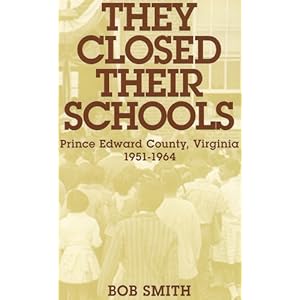
Robert Collins Smith. They Closed Their Schools. Chapel Hill, NC: University of North Carolina Press, 1965.

from Amazon
February is Black History Month, and although March and warmer days are right around the corner, our appreciation of this special designation does not have to come to an end. We can still honor the sacrifices and enormous strides that African Americans have made over the years.

Southside Virginia has the distinction of being a major battleground in the Civil Rights Movement. In addition to being the home of many important leaders, including Vernon Johns, who is considered the father of the movement, a significant battle played out in Prince Edward County during the 1950s and 1960s that affected not only Southside Virginia but also the rest of the United States.

02 December 2011

Alex Kershaw. The Bedford Boys: One American Town's Ultimate D-Day Sacrifice. Cambridge, MA: Da Capo Press, 2003.

Southside Virginia is known for many things: the controversial connection to the groundbreaking HeLa cells that have saved many lives, the powerful meaning Virginia's poet laureate Kelly Cherry conveys in her poetry, the unusual history of moonshine in Franklin County. Unfortunately, Southside Virginia also has the sad distinction of being home to the "Bedford Boys," the group of men who perished on D-Day at Omaha Beach in the Battle of Normandy.
From AmblingBooks.com

Alex Kershaw's documentation of this sad event is more than just another history book. Kershaw heavily researched the town and county of Bedford and how this tremendous loss affected its citizens. And the loss was tremendous: in a single day, twenty-one men from this small community of just over three thousand people were killed. By giving biographies of all involved, the author offers a human side to the statistic that made Bedford's loss the most severe on that pivotal day in June of 1944. The Bedford Boys presents a sound introduction to people interested in visiting the National D-Day Memorial which was opened in Bedford in 2001 because of its significant role in history.

26 November 2011

Lawrence Reveley Burton. Tales of Old Patrick: Enchanting Tales, Mysteries, Poems and Stories. Stuart, VA: L.R. Burton, 1997.

Lone Ivy, Virginia | Summer 2009
At this time of Thanksgiving, I feel it’s appropriate to highlight a collection of short stories that highlights a time in my life for which I am especially grateful. Four years ago in August, I moved to Patrick County, Virginia, to work in the high school as a college counselor for the UVA College Guide Program (now the Virginia College Advising Corps). I arrived not knowing a soul and left with the best circle of friends that a girl could have ever imagined. The two glorious years that I spent there is just one example of how special Southside Virginia is. If you ever have two years to spare, I will give you the rundown, minute by minute, of how fantastic my time really was.

In August of 2007, though, I didn’t know how the next two years would transpire. I rented a basement apartment from the dearest retired guidance counselor, Ella Sue, shared a closet... er, office with the friendliest supervisor, Susan, who invited me to be part of her incredible family and friends, and had two of the most fun fellow College Guides, Sachi and Parisi, in nearby Martinsville. Still, I wanted to really get to know the people and places of Patrick County, and that let me to - of all places - the library!

I’m sure I left with an armload of books, but the one that was the most exciting was entitled Tales of Old Patrick: Enchanting Tales, Mysteries, Poems and Stories by Lawrence R. Burton. As the submitted warned, I was instantly enchanted by the collection of short stories that was published in 1997. I learned all about the history of Patrick County including anecdotes about local people, places, and events.

13 September 2011

Alan Pell Crawford. Unwise Passions: A True Story of a Remarkable Woman -- and the First Great Scandal of Eighteenth Century America. New York: Simon & Schuster, 2005.

photo from Simon & Schuster

These days, celebrity gossip is everywhere, whether we want it or not. An entire industry (think tabloids, public relations firms, TMZ, E!, even your local weekly) is centered around what goes on in the lives of the famous, and the definition of “famous” is forever changing (one word: Snooki). Love it or hate it, society seems to have an indelible appetite for it (and truthfully, I think that some celebrities enjoy the publicity. Obviously Charlie Sheen is winning!). Luckily for those of us who enjoy it, there are plenty of scandals going around to keep us happy – at least until the next big story.

Nearly two hundred twenty years ago, the big scandal that had everyone talking occurred right here in Southside Virginia.

27 August 2011

Matt Bondurant. The Wettest County in the World. New York: Scribner, 2008.

 photo from UNC Libraries

These days, the fact that Franklin County, Virginia, was the “Moonshine Capital of the World” in the 1930s is more of a fun trivia tidbit than something at which to take pause. That's right, Southside's very own Franklin County - not Chicago or New York City - was the mecca for liquor during Prohibition. 

Locals see it as a significant part of our proud history. One can take the Franklin County Historical Society’s Moonshine Express Tour every April, buy knickknacks that tout this designation, and sing along to tunes that shout out specifically to Franklin County’s moonshine enterprise (my favorite: Jean Shepard’s Franklin County Moonshine). The Blue Ridge Institute and Museum at Ferrum College offers an extensive history of the trade in its online exhibit Moonshine – Blue Ridge Style: The History and Culture of Untaxed Liquor in the Mountains of Virginia. A simple Google search will yield results that point to hobbyists’ interest in this topic as well (try here or here), and every so often, larger media venues will also take an interest in it (see the History Channel’s Hillbilly and Rumrunners, Moonshiners, & Bootleggers, National Geographic’s Moonshine documentaries, and this “vintage” news story). Nearby Climax, Virginia, even held an annual Moonshiners Jamboree for a time.

02 May 2011

Rebecca Skloot. The Immortal Life of Henrietta Lacks. New York: Crown, 2010.

photo from The Baltimore Sun

Rebecca Skloot's book is centered around the simple act of a Johns Hopkins doctor taking tissue samples from a sick woman in 1951, but this fascinating story goes much deeper than describing what happened in a lab sixty years ago. Henrietta Lacks, whose cervical cancer cells were taken without her knowledge or consent, was a poor, young mother of five whose body was riddled with cancer. In the decades since her death, her children tried to come to terms to life without their mother. At the same time, scientists and doctors benefited, sometimes financially, from the information that they received from her DNA and cell line, known as HeLa. What made her HeLa cells unique was that they were immortal, which means that they multiplied rather than died like most cells. Because of this, scientific research could be performed that saved many patients' lives. Still, was doing so without any recognition or compensation fair to Henrietta and her family? As Skloot investigated this qyestion, she realized how important it was to tell the story of Lacks and her children. This work - part non-fiction, part memoir - delves into such issues of history, race, poverty, class, and medical ethics.


Find The Immortal Life of Henrietta Lacks in the Charlotte County Library catalog.


Have you read The Immortal Life of Henrietta Lacks? Please share your opinion about the book and this summary.

25 February 2011

Kathleen Grissom. The Kitchen House. New York: Touchstone, 2010.


Lavinia, an Irish girl orphaned on her family’s voyage to America, is taken in as an indentured servant at Tall Oaks, a plantation in Southside Virginia, in 1791. With no memory of her previous life, Lavinia becomes attached to the plantation’s slaves, making them her makeshift family. Over the next few years, Lavinia witnesses the injustices the slaves endure, and they enrage her. She has no real concept of plantation society, although she understands that she is afforded more opportunities, such as learning how to read, because she is white.