Showing posts with label Non-fiction. Show all posts

06 June 2012

Southside Misrepresented: Heidi Schnakenberg's Kid Carolina.

Outrage!

I was having what was supposed to be a quiet, lazy Sunday morning of reading when I almost choked on my coffee. I had just thumbed through the pictures, browsed the index, and finished the introduction of Heidi Schnakenberg's 2010 publication Kid Carolina: R.J. Reynolds, Jr., a Tobacco Fortune, the Mysterious Death of a Southern Icon when I found it. A glaring mistake. Two of them, actually. And both in the very first sentence of the first chapter.

Before we get to the good stuff, let me give you a little bit of context. The Reynolds family is famous in North Carolina for being tobacco people (and you have probably used another product with a link to the family, Reynolds Wrap). In Winston-Salem, there are still marks of the family's legacy: the Reynolds Building (a skyscraper that was the tallest building in the South when it was built in 1929), the Reynolda House Museum of American Art; the Z. Smith Reynolds Library at Wake Forest University, the Smith Reynolds Airport, and numerous organizations that benefited from the Reynolds' charity.

Even Southside Virginia has a strong link to the Reynolds family. The Reynolds Homestead in Patrick County is a cultural hub for local citizens. Restored and donated to Virginia Tech by Nancy Susan Reynolds (sister of R.J. Reynolds, Jr.) in 1970 as a Commonwealth Campus, the Reynolds Homestead features her father's boyhood home, Rock Spring Plantation. The surrounding community of Critz is also home to an elementary school named for Hardin Reynolds (grandfather of Nancy and R.J., Jr.).
What Schnakenberg gets wrong early on is the matter of R.J., Sr.'s birthday and the location of his birth. As you can see in this image, she claims that "Richard Joshua Reynolds Sr., founder of the family tobacco fortune, was born on July 28, 1850, in Critz County, Virginia, where his parents, Hardin and Nancy Reynolds, had settled after their marriage in 1843" (Schnakenberg, p. 1). The inaccuracy of "Critz County, Virginia," struck me first, but I quickly learned from the North Carolina Department of Cultural Resources that R.J., Sr., was born on July 20th, not July 28th (even Wikipedia had both right). [See the mistakes for yourself here.]

There has never been any county in Virginia named "Critz." The area of Patrick County (the true place of R.J., Sr.'s birth) "can be said to have been included in eight different counties since the formation of counties in Virginia" (Patrick County Historical Society, p. 25). These were Charles City (1634-1703), Prince George (1703-1720) Brunswick (1720-1746), Lunenburg (1746-1952), Halifax (1753-1764), Pittsylvania (1764-1776), Henry (1776-1791), and finally Patrick (1791 to present). The 1770 map below, A New and Accurate Map of Virginia shows the enormous Pittsylvania County.
A New and Accurate Map of Virginia (1770) by John Henry. Key for Southside Virginia counties: 3-Amelia, 6-Bedford, 7-Brunswick, 8-Buckingham, 11-Charlotte, 15-Dinwiddie, 23-Halifax, 35-Mecklenburg, 43-Pittyslvania, 44-Prince Edward, 52-Sussex. From http://memory.loc.gov/ammem/collections/petitions/repecomp.html.

Henry County (formed in 1776) was named for Patrick Henry, Virginia's first governor and "one of the firebrands who had helped to stir up the people of the colony in their fervor for independence" (Patrick County Historical Society, p. 38). Fourteen years later, Patrick County was formed from western Henry County. Retaining the honor to Patrick Henry, when one looks at a map of Virginia, they see the two counties, side-by-side, that spell out his name (as seen in the 1920 map below).
From http://www.newrivernotes.com/va/patrick.htm.
Today, Critz is little more than a crossroads with the elementary school, a post office, the Reynolds Homestead, and a handful of churches. As history and heritage shows, there was never a county called "Critz County."

After picking up on these two inaccuracies, I had little interest in reading any further. Sure, they could be the only two mistakes in Schnakenberg's work, but I am skeptical to continue and trust any other information that she has collected.

As it turns out, I am not alone. Although Schnakenberg has received much praise for Kid Carolina (4 out of 5 stars on Amazon and 4.5 out of 5 stars on Goodreads), not all of the press has been positive. Novelist only gives it 2 stars out of five (although this is based on popularity). In the Summer 2010 issue of Dateline, a publication put out by the Reynolda House, Sherold D. Hollingsworth, a Reynolda Researcher, asks "Fact or Fiction? Kid Carolina." Hollingsworth explains that "[n]either Reynolda House Archives nor the Reynolda Researcher was consulted during the writing of this new book and, like other books about the Reynolds family, Reynolda House Museum of American Art takes no position on the accuracy or inaccuracy of the publication" (p. 1). Although the "myths" Hollingsworth corrects are not related to Southside Virginia, it is worth noting that there has been scholarly criticism related to Schnakenberg's work.

So where does this leave us, dear Southside Virginia enthusiasts? Is it worth getting upset about, or should we ignore it? I say yes, and no. Of course it is upsetting when something has been published that is so grossly incorrect. Patrick County had many wonderful aspects, and someone who reads Kid Carolina and looks for a "Critz County" will miss them all together. As a researcher who is constantly scared to death of writing something that is false, I empathize with Schnakenberg. However, I always check and double-check to ensure accuracy, often using various sources to keep everything balanced. I wonder how Kid Carolina was edited and how anyone could let them slip. I urge everyone to do their research... and to always read critically!

References
Early Virginia Religious Petitions. (n.d.). American Memory from the Library of Congress. Retrieved from http://memory.loc.gov/ammem/collections/petitions/repecomp.html
Patrick County, Virginia History, Genealogy. (2006). New River Notes. Retrieved from http://www.newrivernotes.com/va/patrick.htm
Hollingsworth, S.D. (2010). Fact or fiction? Kid Carolina. Dateline, 10(2), 1, 3.
North Carolina Highway Historical Marker Program. (2008). Marker: J-72 - R.J. REYNOLDS 1850-1918. Retrieved from http://www.ncmarkers.com/Markers.aspx?ct=ddl&sp=search&k=Markers&sv=J-72%20-%20R.%20J.%20REYNOLDS%201850-1918
Patrick County Historical Society. (1999). History of Patrick County, Virginia. Patrick County Historical Society: Stuart, Virginia.
Schnakenberg, H. (2010). Kid Carolina: R.J. Reynolds Jr., a Tobacco Fortune, and the Mysterious Death of a Southern Icon. New York: Center Street.
Virginia Tech. (2006). Reynolds Homestead. Retrieved from http://www.reynoldshomestead.vt.edu/
Wikipedia. (2012). R.J. Reynolds. Retrieved from http://en.wikipedia.org/wiki/R._J._Reynolds

---

Have you read Kid Carolina: R.J. Reynolds Jr., a Tobacco Fortune, and the Mysterious Death of a Southern Icon? Please share your opinion about the biography and this summary.

Have you ever read a work of non-fiction and found inaccuracies? What did you do?


23 February 2012

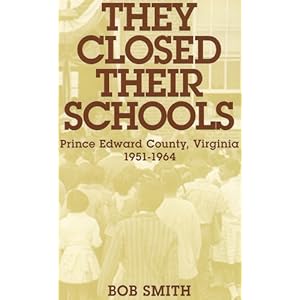
Robert Collins Smith. They Closed Their Schools. Chapel Hill, NC: University of North Carolina Press, 1965.

from Amazon
February is Black History Month, and although March and warmer days are right around the corner, our appreciation of this special designation does not have to come to an end. We can still honor the sacrifices and enormous strides that African Americans have made over the years.

Southside Virginia has the distinction of being a major battleground in the Civil Rights Movement. In addition to being the home of many important leaders, including Vernon Johns, who is considered the father of the movement, a significant battle played out in Prince Edward County during the 1950s and 1960s that affected not only Southside Virginia but also the rest of the United States.

23 December 2011

Southside in the News: Richard's House of Prayer No. 2 an Entertainment Weekly Favorite

Photo by Jeff Vespa, from Skylight Books
Earlier this year, I reviewed Mark Richard’s House of Prayer No. 2: A Writer’s Journey Home. I discussed how I read it thinking that I would know exactly what it would be about and became pleasantly surprised that I was wrong. Richard has lived a remarkable life, and his ability to describe periods of it is outstanding.

photo from The New Yorker
Turns out, I wasn’t the only one who liked House of Prayer No. 2. I was pleasantly surprised this week when I opened my copy of Entertainment Weekly (always reading it from end to beginning for some reason) to find that Richard’s book had been named number one on “The Best Nonfiction” list. That’s right, he beat out the Steve Jobs biography and Tina Fey’s smart and funny Bossypants, another favorite of mine for 2011.

This is great news for Southside Virginia, of course. Although Richard is not from Southside per se, he is from the city of Franklin, which is close enough. What a wonderful way to recognize literary talent from our part of the state (almost)! If you haven't read it yet, pick it up knowing that you're reading a winner!

02 December 2011

Alex Kershaw. The Bedford Boys: One American Town's Ultimate D-Day Sacrifice. Cambridge, MA: Da Capo Press, 2003.

Southside Virginia is known for many things: the controversial connection to the groundbreaking HeLa cells that have saved many lives, the powerful meaning Virginia's poet laureate Kelly Cherry conveys in her poetry, the unusual history of moonshine in Franklin County. Unfortunately, Southside Virginia also has the sad distinction of being home to the "Bedford Boys," the group of men who perished on D-Day at Omaha Beach in the Battle of Normandy.
From AmblingBooks.com

Alex Kershaw's documentation of this sad event is more than just another history book. Kershaw heavily researched the town and county of Bedford and how this tremendous loss affected its citizens. And the loss was tremendous: in a single day, twenty-one men from this small community of just over three thousand people were killed. By giving biographies of all involved, the author offers a human side to the statistic that made Bedford's loss the most severe on that pivotal day in June of 1944. The Bedford Boys presents a sound introduction to people interested in visiting the National D-Day Memorial which was opened in Bedford in 2001 because of its significant role in history.

01 July 2011

Kelly Cherry. Girl in a Library: On Women Writers and the Writing Life. Kansas City, MO: BkMk Press, 2009.

photo from Barnes & Noble

Kelly Cherry, a resident of Halifax County, was recently named Virginia’s poet laureate, so when I picked up her 2009 publication, Girl in a Library, I expected a book of poetry. I am embarrassed to say that I usually run away from the genre, so I was a bit apprehensive to review the book for this blog. Fortunately, I looked closer to read the subtitle – On Women Writers & the Writing Life – and realized that I was wrong.

Rather than being a work of complex poems, Cherry’s Girl in a Library is part memoir, part exploration of life, self, history, gender, art, philosophy – anything, really.

We learn about her (gangster) childhood in an apartment above a grocery store in Ithaca, New York, and her parents’ initial reaction to her desire to become a writer, her unusual first year of college at the University of Tennessee at Knoxville and how a dean (at a different college) made it possible for her to return to higher education, and her decision to write books of poetry after her first novel. She discusses how much she enjoys teaching. Cherry also shares with her readers details of her failed first marriage but also of her happy union today.

At the same time, Cherry writes about fellow writers and their use of characters, time, and settings. She explores the field of literature and what it means to be a female in that world. She questions what it means to be a Southern writer. Truth be told, there were some essays that delved into concepts too complex for me, but it was still a very worthwhile read.

Of particular interest to readers of this blog is her description of her time in Virginia, especially Southside. Cherry spent her adolescence in Chesterfield County and was a student at both the University of Mary Washington and the University of Virginia before beginning her professional career at the University of Wisconsin-Madison in the 1970s. While she has spent much of her life in the South, in the essay “The Globe and the Brain: On Place in Fiction,” Cherry describes her own struggle with writing “southern stories,” calling on Eudora Welty and William Faulkner for inspiration. It truly is a fascinating study in the significance and mystery of Place.

In her retirement, Cherry and her husband bought a small farm in Halifax, which she calls a “pleasure.” Her 2007 book of poetry, Hazard and Prospect, highlights her time in Virginia and points to the influence that her Halifax homestead and the Southside landscape has had on her.

Find Girl in a Library in the Charlotte County Library catalog.

Have you read Girl in a Library? Please share your opinion about the book and this summary.

24 June 2011

Mark Richard. House of Prayer No. 2: A Writer's Journey Home. New York: Nan A. Talese, 2011.

photo from The New Yorker


Say you're reading a book; the story is one that you think you’ll know before you’ve even started reading. In nearly every review and description of the book, authors illustrate that the memoir will detail the life of a "special child" growing up in tobacco-loving Southside Virginia during the 1960s. You might assume that the book will be rather self-congratulatory on the part of the author, Mark Richard, and that you will not be able to relate to him or to his experience at all. On those points, you will be wrong and then most likely right. Richard does not at all seem to be patting himself on the back for the success he has created after an undoubtedly difficult childhood complicated by deformed hips. However, you will probably find it hard to relate to his unbelievable and varied experiences.

02 May 2011

Rebecca Skloot. The Immortal Life of Henrietta Lacks. New York: Crown, 2010.

photo from The Baltimore Sun

Rebecca Skloot's book is centered around the simple act of a Johns Hopkins doctor taking tissue samples from a sick woman in 1951, but this fascinating story goes much deeper than describing what happened in a lab sixty years ago. Henrietta Lacks, whose cervical cancer cells were taken without her knowledge or consent, was a poor, young mother of five whose body was riddled with cancer. In the decades since her death, her children tried to come to terms to life without their mother. At the same time, scientists and doctors benefited, sometimes financially, from the information that they received from her DNA and cell line, known as HeLa. What made her HeLa cells unique was that they were immortal, which means that they multiplied rather than died like most cells. Because of this, scientific research could be performed that saved many patients' lives. Still, was doing so without any recognition or compensation fair to Henrietta and her family? As Skloot investigated this qyestion, she realized how important it was to tell the story of Lacks and her children. This work - part non-fiction, part memoir - delves into such issues of history, race, poverty, class, and medical ethics.


Find The Immortal Life of Henrietta Lacks in the Charlotte County Library catalog.


Have you read The Immortal Life of Henrietta Lacks? Please share your opinion about the book and this summary.